Ken MacLeod's comments.
The title comes from two quotes:
“If these are the early days of a better nation, there must be hope, and a hope of peace is as good as any, and far better than a hollow hoarding greed or the dry lies of an aweless god.”—Graydon Saunders
Contact: kenneth dot m dot macleod at gmail dot com Blog-related emails may be quoted unless you ask otherwise.
Emergency Links
British Red Cross
Disasters Emergency Committee
UNICEF
Hurricane Relief
American Friends Service Committee
LINKS
Self-promotion
Buy my books
Buy signed copies!
Follow me on Twitter!
The Human Genre Project
The Human Genre Project
Comrades and friends
Charlie Stross
Martin Wisse
Making Light
Avedon Carol
The Pagan Prattle
Cheryl's Mewsings
Farah Mendlesohn
Bridesmaid
Svein Olav Nyberg's old blog
Svein Olav Nyberg's new blog
Alister Black
Kevin Williamson
Alan Freeman
Kathryn Cramer
MaxSpeak
Jim Henley
John Baker
Nicholas Whyte
The Sharp Side
Barbaric Document
The Woolamaloo Gazette
Kevin Carson
Thomas Knapp
Arthur Silber
Grand Hotel Abyss
Devizes Melting Pot
A Finer World
Austro-Athenian Empire
The Art of the Possible
Cupcake Couture
Brian Micklethwait
Diane Hannover
TJ's Place
Mat Coward
Iain Fraser Grigor
Gail Wendorf
ubiquitous surveillance
Dubious Prospects
Ilorien
Sharon King
Kristine Lowe
Rich Puchalsky
Lamontations
Cory Doctorow
Parallel Futures
Lord Dunderheid
Colleagues
Genomics Forum
Genotype
Forum Tweets
the write reality
Pippa Goldschmidt
My Forum page
Sociology, Genomics and SF
EUSci
The University of Edinburgh
Genomics
What Is Genomics?
What is Synthetic Biology?
SynBioStandards
Genetic Future
Genetic Inference
Action Bioscience
Cardiff sciSCREEN
Genomic Minds
The Fourth Domain
Edinburgh
Guardian Edinburgh blog
The Edinburgh Reporter
City of Literature Trust
Textualities
Writers Bloc
Word Power
Transreal
McShandy's
Forest Publications
The Forest Cafe
Avalanche Records
Scottish Knife Collection
Sea Kist
Joyce Paton
Chris Koujou
Author Portraits
Luath Press
Tychy
Dig-In Bruntsfield
Writers Blog
SF Writers' blogs
Dead by Dawn
Forbidden Planet
Ian McDonald
The Mumpsimus
Dr Ian Hocking
Barbaric Document
Mundane SF
Justina Robson
Neal Asher
Michael Rosen
Warren Ellis
John Scalzi
Sean Williams
Jack Deighton
Rudy Rucker
Glenda Larke
Alan Campbell
Gavin Inglis
Hannu Rajaniemi
Lou Anders
Nick Harkaway
Paul McAuley
Lois McMaster Bujold
LabLit
M. John Harrison
Kelley Swain
Robert J. Sawyer
Will Shetterly
Stefan Pearson
aiko writes: poems
The Lost Book
The Trease Project
Peter Watts
Karla Schmidt
Deborah J Miller
Juliet E McKenna
Mike Cobley
Philip Palmer
Nick Wood
Catherynne M. Valente
Gail Carriger
Liz Williams
Morag Edward
Adam Roberts
Jo Walton
Nicola Griffith
Alastair Reynolds
Kari Sperring
Alan Bissett
My Writing Life
Helen Jackson
Caroline von Schmalensee
N. K. Jemisin
Cici James
Joan Slonczewski
Gwyneth Jones
Michael Rosen
Ryan Van Winkle
C.J. Cherryh
Russell Jones
Georgina Bruce
Katrina Leno
Claire Askew
Steven Brust
Mary Robinette Kowal
Regi Claire
Ron Butlin
Ruth Sabath Rosenthal
Jaine Fenn
Nnedi Okorafor
Editor Blogs
John Jarrold
Publisher Blogs
Tim Holman
Brother Blogs
MacLeod Cartoons
Skiffy
Ansible
Redstone SF
Futurismic
SciFiDimensions
io9
Tor.com
Pyr
Orbit
PS Publishing
Feminist SF
World SF News
Biology in SF
Raritania
Steampunk Fashion
Torque Control
Post-Weird Thoughts
Ivor W. Hartmann
StarShipSofa
Star Wars Modern
The Outer Alliance
Eve's Alexandria
Beyond Victoriana
Strange Horizons
Salon Futura
Afrocyberpunk
pornokitsch
SciFi Ideas
Three, If By Robots
Brits Blog
The Sharpener
The Register
Velvet Glove, Iron Fist
Blood and Treasure
The Gaping Silence
The Yorkshire Ranter
Excuse Me Whilst I Step Outside
' ... a treeless, flowerless land, formed out of the refuse of the Universe, and inhabited by the very bastards of Creation'
Socialism First!
Red Paper
Aye We Can!
Bella Caledonia
Scottish Roundup
Scottish Politics
SSP
Solidarity
Scottish Left Review
Democratic Left Scotland
Between the Hammer and the Anvil
SNP Tactical Voting
A Place to Stand
Freedom and Whisky
Independence
Gerry Hassan
Better Nation
Bright Green Scotland
Caledonian Mercury
Lallands Peat Worrier
Lesley Riddoch
Clyde Space
Spaceport Scotland
Land Matters
Scottish Review
Scottish Review of Books
The Firm
STV Local
Frontiers
Whitehall 1212
Ian Smart
Notes from North Britain
Amazing Things
Astronomy Picture of the Day
Hubble Telescope
Fragile Oasis
Stanford Encyclopedia of Philosophy
Dictionary of the History of Ideas
Internet SF DataBase
Arts and Letters Daily
3 Quarks
1911 Britannica
Wikipedia
BBC
Daily Mash
Fortean Times
BoingBoing
Three-Toed Sloth
James P. Hogan
MemeMachineGo!
small WORLD
Derelict London
Good News
Strange Maps
The Simulation Argument
Better Living Through Chemistry
Poems on the Book of Life
The Periodic Table of Science Fiction
RAW Illumination
The Realist Archive
The New Atlantis
Faith
Flat Earth
Fixed Earth
Geocentricity
6 ky Earth
10 ky Earth
4.5 Gy Earth
Creation Wiki
Sacred Texts
The Brick Testament
The LOLcat Bible
Reason
New Humanist
Edinburgh University Humanist Society
WTA
IEET
Cyborg Democracy
Nick Bostrom
Bad Astronomy
WorldChanging
Cosmic Variance
Sean Carrol
Bruce Schneier
i-studies
The Eternal Golden Braid
The Secular Web
NSS
Richard Carrier
Russell Blackford
Conscious Entities
David Chalmers
the Edge
Naturalism.Org
Talk Reason
Stephen Law
Science after sunclipse
The Threat to Reason
Atheists of Silicon Valley
Blag Hag
Rationally Speaking
Bad Science
Enemies of Reason
Tabloid Watch
Daily Mail Watch
Perpetual Motion
Skepticblog
This is What a Scientist Looks Like
Freethought Blogs
Crooked Timber
Kenan Malik
Atheism: Proving the Negative
Stoicism Today
Sense about Science
Evolution
Why Evolution is True
The Panda's Thumb
Pharyngula (SciB)
Pharyngula (FtB)
RichardDawkins.net
The Voyage of HMS Beagle
Evolving Thoughts
The Lancelet
Pleiotropy
The Digital Cuttlefish
Glenn Morton's Pages
Talk.Origins
Creation Science and Earth History
Creation 'Science' Debunked
ASA
The GeoChristian
NCSE
BCSE
Oolon Colluphid's Guide to Creation
Recovering YECs
Beyond the Firmament
Highly Allochthonous
Caught in a Bad Project
Playing Chess with Pigeons
Shit You Didn't Know About Biology
War and Revolution
Antiwar.com
Lenin's Tomb
Empire Burlesque
CounterPunch
World Socialist Web Site
British Army Rumour Service
Circling the Lion's Den
International Crisis Group
Baghdad Burning (Riverbend)
Iraq Today
Left I on the News
Informed Comment
Informed Comment Global
Tom Dispatch
It's No Accident
Empire Notes
the eXile
The Exiled
Inanities
Matt Carr's Infernal Machine
MidEast Shuffle
The Duck of Minerva
In the Mind Field
Mutualist Militants
Free Market Anti-Capitalism
Larry Gambone
Red Lion Press
crispin sartwell
In the Libertarian Labyrinth
Liberty Alone
Rad Geek People's Daily
Propaganda Lalaland
Markets Not Capitalism
Democratic Socialists
Scottish Labour
Tom Harris MP
Bob Piper
LabourList
Socialist Party, USA
Socialist Webzine
Chartist
Appeal to Reason
Labour and Capital
Left Futures
grimmerupnorth
The Bickerstaffe Record
The Socialist International
Labour Lords
Scarlet Standard
Shifting Grounds
Renewal
Impossibilists and Ilk
SLP
SPGB
Socialist Studies
Socialism or Your Money Back
Inveresk Street Ingrate
Vaux Populi
Mission
Timid Maximalist
Class Warfare
Reasons to be Impossible
Mailstrom
Ragged Trousered Philanthropist
Wobbly Times
Viva La Quarta
International Viewpoint
In Defence of Marxism
SWP
Socialist Worker (UK)
Socialist Worker (US)
International Socialism
Socialist Action (US)
CWI
AWL
Anti-SEP-tic
Socialist Action
Communist Parties
CP of Britain
CP of Ireland
CPUSA
CPI(M)
Iraqi CP
CP of Israel
SACP
ML Today
SolidNet
21centurymanifesto
Revolting Europe
L'Humanite in English
Other revolutionaries
CPGB
Worker-communist Party of Iran
the commune
Radical Resources
Housmans Bookshop
Morning Star
Critiques of Libertarianism
Hitler was a Capitalist
Labournet UK
China Labour Review
Marxists Internet Archive
From Marx to Mao
Leninist.biz
Autodidact
Amiel & Melburn Trust
The New Reasoner
Lawrence & Wishart
hegemonics
Marxsite
Marxmail
Marx Myths
Revolutionary History
Monthly Review
What Next?
William Blum
Grover Furr
Bertell Ollman
What's Left
Reality
Paul Cockshott
Critique
The Socialism Web Site
Spectrezine
21st C. Socialism
SolidarityEcon
Left Atomics
Socialist Economic Bulletin
naked capitalism
Thoughts on Economics
Debunking Economics
Research on Money and Finance
Southall Black Sisters
Ancient Communism
Key Trends in Globalisation
Readable Reds
Splintered Sunrise
Soviet Goon Boy
Renegade Eye
Dave's Part
Cedar Lounge
Unrepentant Marxist
Though Cowards Flinch
Mark Steel
Critical Montages
The Curmudgeon
A few words before we go
Stephen Gowans
Liam Mac Uaid
Socialist Unity
Southpaw Punch
Harpy Marx
Madame Miaow
Reading the Maps
Stroppy Blog
A Very Public Sociologist
Tendance Coatsey
Boffy's Blog
Penny Red
Show Biz Red
Stalin's Moustache
Lipstick Socialist
For the sake of the argument
Norman Geras
Sean Gabb
Libertarian Alliance (Official)
Libertarian Alliance (Provisional)
Libertarian Party UK
Spiked Online
Poumista
![[Powered by Blogger]](https://lh3.googleusercontent.com/blogger_img_proxy/AEn0k_t1-_N3EIYkNbQrbViNcj3TrFDbKctsWQPZcBf51QP9xrJeBEePKpGGha7kGpekHMuZUSJ6bQcCMTBhr3zrCDwI0nndTcCmh93nwxcJH-86=s0-d)
Carol’s funeral

More people came to Carol’s funeral than there were seats in the crematorium chapel: our families, her friends and mine, some of whom had travelled a long way. The funeral directors, P B Wright and Sons, took care of the arrangements kindly and professionally. Catriona Miller, the humanist celebrant, conducted the service and delivered a warm and accurate tribute to Carol. I spoke about Carol’s life with me, and Michael spoke for himself and Sharon about Carol as a mother. Two hymns were sung that had also been sung at our wedding. The closing music was a song Carol had played countless times: ‘Stars’ by Simply Red.
The Order of Service booklet featured a fine recent photograph of Carol by Michael, and some of Carol's own photographs of Gourock's sunset skies.
The collection was for two charities that Carol had actively supported: the RNLI, and Medical Aid for Palestinians. It raised £1138.50, which yesterday I rounded up to £1200 and divided evenly into two donations in her memory.
Many, many thanks to all who attended, and to all who contributed so generously, at the collection and online. Thanks also for the many messages and cards of sympathy, for which I and all the family are deeply grateful.
Carol Ann MacLeod, 11 February 1952 to 16 August 2024

She was the centre of my world, and she's gone.
There will be a funeral service at Greenock Crematorium, on Monday 2 September, at 2 pm, to which all family and friends are invited. Family flowers only please. There will be a retiral collection in aid of Carol's favourite charities.
My Glasgow Worldcon Schedule

As some of you may know, I'm a Guest of Honour at the Glasgow Worldcon. I haven't said enough about that here, I know. I'm well chuffed about it, needless to say. Here are time/places where you can be sure to find me.
Autographing: Ken MacLeod, Thursday 8 August 2024, 13:00 GMT+1, Hall 4 (Autographs)
Opening Ceremony, Thursday 8 August 2024, 16:00 GMT+1, Clyde Auditorium
Morrow's Isle - Opera, Thursday 8 August 2024, 20:00 GMT+1, Clyde Auditorium
Iain Banks: Between Genre and the Mainstream, Friday 9 August 2024, 11:30 GMT+1, Alsh 1
Luna Press Book Launch Party, Friday 9 August 2024, 13:00 GMT+1, Argyll 2
Guest of Honour Interview: Ken MacLeod, Friday 9 August 2024, 16:00 GMT+1, Lomond Auditorium
Table Talk: Ken MacLeod, Saturday 10 August 2024, 11:30 GMT+1, Hall 4 (Table Talks)
The Making of Morrow's Isle - An Opera, Saturday 10 August 2024, 14:30 GMT+1, Argyll 2
NewCon Press Book Launch, Saturday 10 August 2024, 16:00 GMT+1, Argyll 3
The Politics of Modern Scottish SF, Saturday 10 August 2024, 20:30 GMT+1, Castle 1
Reading: Ken MacLeod, Sunday 11 August 2024, 10:00 GMT+1, Castle 2
Autographing: Ken MacLeod, Sunday 11 August 2024, 11:30 GMT+1, Hall 4 (Autographs)
An Ambiguous Utopia: 50 Years of Ursula K. Le Guin's The Dispossessed, Sunday 11 August 2024, 14:30 GMT+1, Meeting Academy M1
2024 Hugo Awards Ceremony, Sunday 11 August 2024, 20:00 GMT+1, Clyde Auditorium
Stroll with the Stars - Monday, Festival Park, Monday 12 August 2024, 09:00 GMT+1, Outside Crowne Plaza
Writing Future Scotland, Monday 12 August 2024, 13:00 GMT+1, Lomond Auditorium
Chengdu Worldcon: Meet the Future

This historic Worldcon has already been very well covered by others, e.g. Nicholas Whyte and Jeremy Szal. For lots of coverage of events, guests and so on, see the con’s Facebook page.
But I’ve been back over a week, and here’s my overdue account.
Last month I spent far too few days in China, at the Chengdu Worldcon, to which I was invited as an international guest. My travel, and accommodation for me and my wife, were covered by the Committee of the 2023 Chengdu World Science Fiction Convention, for which much thanks.
We had a wonderful time. The convention was a smashing success and easily the biggest, and most publicly celebrated, Worldcon ever.
We arrived at Chengdu airport in the early evening of Wednesday 18 October and quickly met volunteers at a stall near the exit, from which were immediately hurried to a minibus that took us to the Sheraton Pidu. Along the way we saw advertisements for the Chengdu Worldcon lining the highways, and the robot panda mascot at numerous intersections. We met the volunteer who was looking after us, Zoe, who was unfailingly sweet and helpful throughout. Our luggage was whisked inside and we were back on a bus for a short drive to the venue.


This combined a traditional Worldcon opening ceremony...


The other ceremonies – the Galaxy Awards, the opening of the Chengdu International Science Fiction convention, the Hugo Awards, the Hugo after-party, and the closing ceremony – were likewise spectacular: a primary school choir sang in one of these, an entire symphony orchestra took the stage in another, and so on.


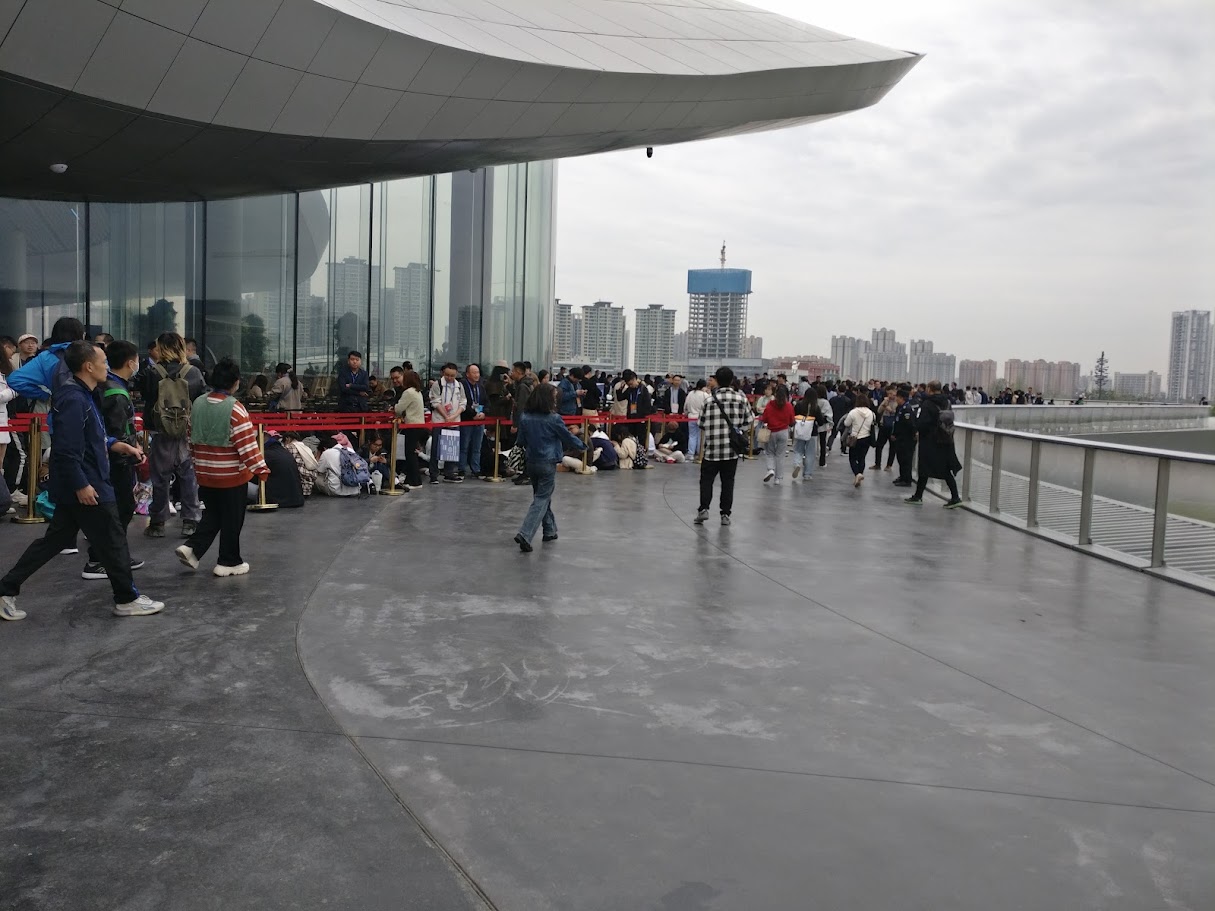
Thousands upon thousands of people passed through the venue, including many primary-school classes there for the day. Lots of young people, and lots of families. They weren’t just there for the toys and for the impressive tech exhibition hall.


There were hundreds of volunteers, some minding the international guests, others helping visitors to the venue, acting as guides in exhibitions, or adding some elegance to the ceremonies.

Our good friend Fan Zhang, who looked after us so well in Beijing in 2019, now has an important post at the Fishing Fortress college of Science Fiction. He took us out to dinner with two of his staff, and had some interesting proposals for next year, which I’m seriously considering.
We had one side trip organised by the convention for guests: a visit to Chengdu’s famous panda research centre, truly unforgettable.


On our final day, Monday 23 October, Carol and I went on our own to the Wuhou Shrine, a historic site and major tourist destination set in a great park which opens to some old streets, now lined with gift shops and street food stalls.


And on Tuesday we began the long journey home. We had met old friends and made new ones, and it was a pang to leave.

We owe thanks to many people – the organisers and volunteers, especially Zoe, and a special thanks to the indefatigable Sara Chen.

Cosmia Festival
£10 for the day, with a great range of authors, plus workshops and exhibitions: details and bookings here.
Moniack in a Month – Writing Science Fiction

I’m delighted to say that bookings are now available for an online course on writing science fiction which I’ll be teaching this September. Details are here. The wonderful Justina Robson has kindly agreed to be our Guest Reader.
Lightspeed trilogy publication news: UK and US

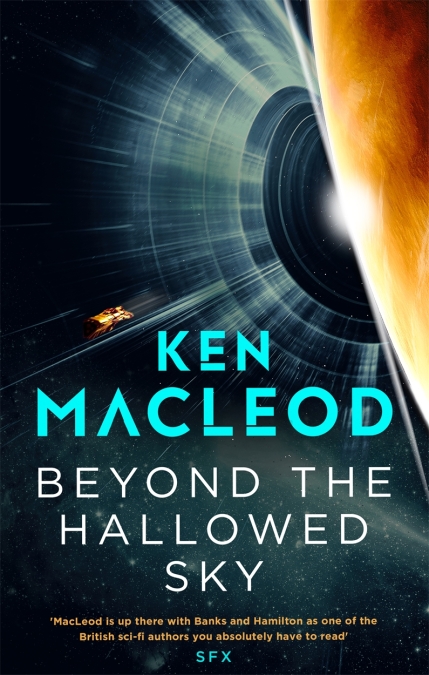
A day later came the US publication of the first book, BEYOND THE HALLOWED SKY, by Pyr Books and available via Simon and Schuster, with links to Amazon and other online bookshops.

This book has had kind words from North American authors:
Ken Macleod does things nobody else does and this is a terrific read. – Jo Walton, multi-award-winning author of Among Others and What Makes This Book So Great
Sure, some writers knock it out of the park but with Beyond the Hallowed Sky, Ken MacLeod knocks it right out of the solar system! Too often, space opera throws science out the airlock, but MacLeod has given us a believable faster-than-light adventure that will have you racing through the pages at superluminal speed. – Robert J. Sawyer, Hugo Award-winning author of The Oppenheimer Alternative
An exceptional blend of international politics, hard science, and first contact.
- Michael Mammay, author of the Planetside series.

Interview
Address to the Edinburgh Science Festival Church Service 2022
The theme of this year’s Science Festival is Revolution. This is an apt topic here in St Giles, which after all is the very spot where the revolution, in the then Three Kingdoms, began: a revolution that created modern Britain. But whether Jennie Geddes is real or legendary, I hope no chairs are hurled at the pulpit today. So, steering well clear of religion or politics, I’d like to talk about how we talk about politics, and when and why people started talking about revolution. Interestingly enough, it was at about the same time that our revolution happened, in the seventeenth century.
In the same century, and perhaps by no coincidence, there was a scientific revolution. The mechanics of Galileo and Newton was the subversive science of its day, challenging the metaphysical doctrines of ancient tradition as shatteringly as the artillery it helped to aim battered down the walls of lordly castles. And it left its mark on our language of politics.
When you look at the language and vocabulary that we use to describe political events, you find a surprising number of words from seventeenth-century physics and astronomy. Revolution in that context meant a complete turning of a wheel, or the circuit of a planet in its orbit – the revolutions of the heavenly bodies, as Copernicus titled his revolutionary thesis. And revolution, as a metaphor in politics, originally meant something very similar – a return to the starting point.
At the time it must indeed have seemed like that. You get rid of a King, you fight a civil war and end up with a Protector, and then the Protector dies and before you know it you have a King again. And everything seems to be back in the same place as it was before: after the Interregnum, the Restoration. Looking back, people in later centuries could see more clearly that it was not: that some things had changed irreversibly, and the revolution, you might say, kept rolling on.
We still talk of masses, which may or may not be in motion. We speak of political and social movements, which may or may not have certain dynamics. We evaluate the balance of forces. If we’re politics professors or journalists, we may ponder the electoral cycle. We may look at a social or political system – and that word too, system, originates in astronomy – and ask whether the system is stable or unstable, or whether or not it is in equilibrium. We may investigate the system’s mechanics. We may despair at the system’s inertia, and hope, perhaps in vain, for some impulse or even momentum to change it. And can the change we seek or fear be accelerated, or retarded? Should we worry about possible retrograde developments? Will our action in the end produce a reaction?
It’s Newtonian mechanics all the way down! Well – perhaps not quite. There are some other sciences that we draw on for political metaphor: the idea of a political upheaval surely comes from geology, as does a political earthquake, when the tectonic plates of politics shift. (I wonder how many years of the Edinburgh Science Festival, and how much toil of primary and secondary school teachers, and how many school visits to Dynamic Earth it took before plate tectonics became a political metaphor that everyone could understand!)
Our most troubling political language comes from biology, and evolutionary biology in particular. The metaphors of competition, of natural selection, of struggles for existence have been applied and misapplied with dire consequences. This pains me greatly, not least because I trained as a zoologist. Now, I’ve read Darwin, and for my sins I’ve even read Herbert Spencer, and I can honestly say that in these matters they are both much maligned. There is no basis in their work, let alone in modern biology, for any kind of racial politics. But when the founding text of a discipline is titled On the Origin of Species by Means of Natural Selection, or the Preservation of Favoured Races in the Struggle for Life it’s all too easy to see how misunderstandings could arise.
Is there a biological science that might offer us a more fruitful language for politics? I think there is: ecology. It’s already provided us with two familiar terms in politics: sustainability, and diversity. Ecology examines all forms of life in interaction with their physical environment and with each other, and identifies and measures the flows of energy and material among them. And humanity, of course, is now a somewhat important form of life, and affects these flows on a planetary scale, not always entirely for the good of itself, let alone the rest.
Ecology, I think, is as subversive a science in our time as Newton’s mechanical philosophy was in his. Why? It delivers warnings about what our interactions with the rest of nature are doing to us and to the planet, certainly. But it does more. It suggests a science of ourselves that starts with our relationship with the rest of nature, and with each other. Like it or not, we all need food, drink, and shelter, and like it or not we can only get them from the rest of nature and in and through relationships with other people. Human beings can’t sustain themselves individually, like the sea-birds outside my window, or co-operate instinctively, like the ants in my back yard. We’re social and productive by necessity but not by instinct, so we must rely on thought and speech. To make our living together, we have to speak and think, imagine and create, question and discover. An ecologically inspired science of humanity could start from these facts, and trace the flows of material and energy through human society and back to the earth and air and water around us. It could ask what people think they’re doing, and investigate what they’re actually doing. It might dig up all kinds of inconvenient truths about where stuff comes from, where it goes, and how it gets there -- and who gets it, and who gives. And if these connections became widely known and understood, people might want to change a lot of what goes on.
Perhaps we need a better metaphor for change than revolution. One that has always stuck in my mind is ecological succession. On land left bare by ice or fire or landslide or flood, different populations of plants, animals and fungi settle in well-defined stages, each incomplete and unstable in itself, each more complex and diverse in its components and their interactions, until finally there arises what is called the climax community, a combination of species that is self-sustaining and self-reproducing: a mature forest, for example. The more complex and various the community, the more stable and resilient it is. Is such complexity and diversity, then, that we should expect and work towards in our human community? What would a climax community of humanity look like? Are we there yet? I’ll leave these questions open. I’m not here to preach.

BEYOND THE HALLOWED SKY
It’s the first volume of the Lightspeed Trilogy, and the second volume is well underway.
What does fiction tell us about our hopes and fears for technology?
4.30pm – 5.05pm GMT, 8 December 2021.
Register for free here.


‘Nineteen Eighty-Nine’

The story has been long in the making. Sometime in the early 1990s I had an idea for a story called ‘Nineteen Eighty-Nine’, in which events like those of 1989 in our world happen in the world of George Orwell’s Nineteen Eighty-Four. I wrote it and sent it to Interzone, and they sent me a kind rejection note suggesting that I try a local fanzine. I sent it to the local fanzine New Dawn Fades, and they rejected it. The editor softened the blow by encouraging me to write something else for them. They later accepted, I think, a review and a poem. But for the moment, I was done with short stories. After that, there was nothing for it but to write a novel.
That’s the story I’ve told now and again, usually with the punch-line that the best thing about the story was the title, because it tells you exactly what the story is about.
Now I’m going to have to retire that anecdote.
Earlier this year, shortly after I had read that Orwell’s fiction was now out of copyright, Ian Whates emailed me to ask for a story for a new venture he was planning. I pitched ‘Nineteen Eighty-Nine’. Ian was keen, so I looked at my old story (or what I could find of it), decided it was beyond help, and wrote an entirely new story. I’m fairly sure it’s an improvement on my first attempt.
One inspiration for the new version was the article ‘If there is Hope’ by Tony Keen, in Journey Planet #3 (pdf). Another was the article Orwell on Workers and Other Animals, by Gwydion M. Williams, which makes the intriguing point that 1945 is missing from the world of Nineteen Eighty-Four.
While writing the story I chanced on a clue to Orwell’s pessimism that, as far as I know, has escaped scholarly attention. Orwell, it turns out, had read and been impressed by George Walford's pamphlet The Intellectual and the People.
Walford drew on his mentor Harold Walsby's The Domain of Ideologies, the founding text of what Walford later called Systematic Ideology. This argued that the major social outlooks form a historical, numerical, and political series in decreasing order of antiquity, size, unity, and radicalism. The (historically) oldest and (currently) largest group is the apolitical, followed by the conservative, the reformist, the revolutionary, and the anarchist ... with the tiniest, least effectual and most extreme group being the Systematic Ideologists themselves, who understand the whole process but can't think what to do about it.
More about this another time, but it seems to me significant that Orwell attributed political apathy, ignorance and indifference to – not 'perhaps the largest single group' of the population, as Walford did – but to the vast majority: 85%.
Vaping

--- Lady at bus stop, a few months ago.
You might think it bad taste to talk about vaping in the middle of a pandemic, and you'd be right. But this hasn't stopped a slew of public health bodies, politicians, and activists from doing just that, so I see no reason to unilaterally disarm.
If you want some proper science and good sense on the topic, follow Clive Bates on Twitter, and read his excellent blog. Meanwhile, here's my own overdue rant.
I've been meaning to blog about vaping for a while. My Twitter feed sometimes seems to be about little else, rather to my embarrassment whenever I scroll through it. So I'll start by explaining why it matters to me. As with many vapers, my story begins with smoking.
To cut that long story short: I smoked, first a pipe then cigarettes, from my early twenties to my late fifties. I tried to quit many times. The annual ratchet of tax rises in the Budget reliably brought on another attempt. Surely I'll stop, I told myself, when they're over 50p a pack! Not even the £10 pack did the trick. Neither did Allen Carr's book, willpower, shame, and the pub smoking ban. One day about ten years ago I saw an electronic cigarette in a petrol station, and bought it. It was shaped like a cigarette and had a tip that glowed when you drew on it. After buying a few of these and finding it inconvenient when they ran down I soon was ordering the same brand with rechargeable batteries and replaceable cartridges. I was still smoking, but a bit less than before, and the ecig made pub conversations much more convivial and less often interrupted than they'd become. The kick was feeble, the nicotine faint, the taste indifferent, but it was better than nothing.
Then a student in a mid-morning break at Napier showed me a more advanced e-cig, with a refillable tank, and told me where to get them. That very lunchtime I hastened over the hill to Emporium Vapour at Gorgie Road, and bought a starter kit. Within weeks, and without trying, I'd gone from smoking a pack of cigarettes a day to a pack a month. I went from tobacco flavours to fruit, menthol, spearmint... eventually settling on Kiwi and Strawberry, a half dozen tiny bottles of which I've just ordered. I smoked what turned out to be my last cigarette in the early hours of New Year's Day, 2016. Vaping had succeeded where decades of New Year resolutions had failed.
In the meantime, I'd been through the battle over the EU's Tobacco Products Directive, which saw concerted efforts to ban or severely restrict vaping and frantic, largely self-funded efforts by vapers to save it. We all learned a lesson in how EU laws are made. The vaunted principles of transparency, evidence, proportionality and subsidiarity didn't, let's say, stand out. The outcome was some pointless, petty and harmful regulation that wasn't as bad as we'd feared – and thousands more people in Britain who hated the EU and were active, informed and outspoken about it on social media. I'm not saying it swung the referendum, but it can't have helped.
The real threat to vaping, however, came from the United States. As long as vaping was a hipster fad, it could be fought by ridicule and junk science, of which there was plenty. The typical experiment involved burning out ecig coils and forcing mice to breathe the resulting toxic smoke for a month. The results of the mouse autopsies could then be turned into excited press releases and even more excitable headlines.
Another line of attack was that the vaping industry – or, absurdly, the tobacco industry – was 'targeting kids'. In US usage, 'kids' can mean anything from toddlers to graduates, but let's be generous and assume it meant in this case teenagers. The massed ranks of mom and pop businesses and evangelical ex-smoker start-ups that made up Big Vape in those days were allegedly targeting teenagers with 'kid-friendly' flavours: sweet and fruit flavours, sometimes with names reminiscent of the kind of candies actual kids like. 'Gummy bears' was a common talking point. The slogan, repeated to this day, was 'Flavours hook kids'. The claim makes sense until you give it a moment's thought.
When you do give it a moment's thought, you recall that teenagers are anxious to put away childish things, to take on the trappings of adulthood as quickly they can, and to defy the conventions and pieties of the adult world as annoyingly as they can. This is, of course, one reason why they smoke cigarettes. If you wanted to appeal to teenagers, your ideal vape flavour branding would be redolent of tobacco harvested by slaves, shipped by pirates, imported by smugglers and smoked by highwaymen.
The real 'target' (i.e. market) for fruit and sweet flavoured vapes was people like me: adult smokers and ex-smokers and would-be ex-smokers. Smokers who take up vaping usually start with imitations of their familiar tobacco flavours, but fairly soon (perhaps because the imitations are not all that convincing – copying tobacco flavour has turned out to be surprisingly difficult) move on to sweet and fruit flavours. If these flavours are presented as having the generic tastes of sweets they enjoyed in childhood (and may not have tasted since, for the sake of their teeth or their waistlines) all the better -- it adds a touch of harmless nostalgia.
And that market – unlike the pocket-money, illegal market of high-school students – is huge. But open-tank vaping doesn't appeal to all of them. If only there was a product as convenient as cigarettes! A start-up company set out to design just that, and succeeded. Juul is a slim device with a USB-cable rechargeable battery and replaceable cartridges of liquid. It gives the same instant nicotine kick as a cigarette. So I'm told – thanks the above-mentioned petty EU regulations, the high-nicotine pods aren't available here.
The trouble with Juul was that these devices really did appeal to teenagers, mainly if not wholly the very teenagers who would otherwise have been (or indeed already were) smoking cigarettes. Juul and similar devices are easy to conceal, almost undetectable in discreet use, and leave no tell-tale smell. This duly set off a moral panic – at the same time as the prevalence of actual cigarette smoking among teenagers dropped to a historic low. The 'Flavours hook kids' nonsense has driven ban after ban on flavoured vaping liquids. This was (and is) bad enough.
Then came disaster.
Cannabis use is illegal in the US at a federal level, but in the past decade some states have legalised it: first for medicinal use, then recreationally. The possibility of vaping cannabis didn't escape attention, and was soon realised. Legal weed stores sell an eye-watering variety of vape pens and cartridges, as well as cannabis cakes, candies and for all I know actual leaf. Because it's legal in some places but not in others an illegal market soon sprang up. Some of the criminal entrepreneurs supplying it found that they could cut cannabis-based oils with thickening agents, one of them Vitamin E acetate. This turned out to be deadly. More and more people were rushed to hospital, and scores have died, with severe lung injuries. The source of the problem was soon exposed by the legal cannabis industry. It was obscured at first because the victims had often been vaping cannabis illegally (because of their age or location) and admitted only to 'vaping' or even, more alarmingly, to 'juuling'. Blood tests, however, soon showed what they'd been vaping. It wasn't nicotine.
The lie ran around the world before the truth got its boots on. Certain US public health authorities, notably the Centers for Disease Control, did their utmost to warn against 'vaping' and 'e-cigarette use' in general and almost nothing to warn against vaping illegal cannabis in particular. The misconception, to put it no more strongly, persists and is reinforced by various public health authorities, lazy journalists, and anti-vaping activists to this day.
That's why the little old lady at the bus stop kindly advised me to go back to smoking.
Best of British Science Fiction 2019

Contents
• 2019: An Introduction – Donna Scott
• The Anxiety Gene – Rhiannon Grist
• The Land of Grunts and Squeaks – Chris Beckett
• For Your Own Good – Ian Whates
• Neom – Lavie Tidhar
• Once You Start – Mike Morgan
• For the Wicked, Only Weeds Will Grow – G. V. Anderson
• Fat Man in the Bardo – Ken MacLeod
• Cyberstar – Val Nolan
• The Little People – Una McCormack
• The Loimaa Protocol – Robert Bagnall
• The Adaptation Point – Kate Macdonald
• The Final Ascent – Ian Creasey
• A Lady of Ganymede, a Sparrow of Io – Dafydd McKimm
• Snapshots – Leo X. Robertson
• Witch of the Weave – Henry Szabranski
• Parasite Art – David Tallerman
• Galena – Liam Hogan
• Ab Initio – Susan Boulton
• Ghosts – Emma Levin
• Concerning the Deprivation of Sleep – Tim Major
• Every Little Star – Fiona Moore
• The Minus-Four Sequence – Andrew Wallace
My short story 'Fat Man in the Bardo', originally published in Shoreline of Infinity 14, and I'm well chuffed to see it here.
(TOC layout copy and pasted from the redoubtable Lavie Tidhar, who as you can see also has a story in it.)
Solidarity stories

So I was happy to contribute a story to an anthology of SF, fantasy and horror conceived and edited by Ian Whates at NewCon Press, and compiled and published with breathtaking speed. At a quarter of a million words from some of the leading names in the field, a paperback version would be an epoch-making brick that cost a significant chunk of cash. Electronic and weightless, Stories of Hope and Wonder is a steal at £5.99 / $7.99. Every penny of the proceeds goes straight to providing PPE and other support to UK healthcare workers. A significant amount, I understand, has already been raised and donated. More is needed.
They can't wait. Buy it now.
Lockdown gigs

I'm not sure if Selkie Summer meets the criteria for paranormal romance, but it's still about a young woman who falls for a paranormal entity. It's set in a contemporary Scotland much like ours, except that certain paranormal entities definitely exist and this is taken for granted as a fact of natural history. Partly as a consequence, there is no Skye Bridge.
It was due to be launched by me and Ian at Cymera 2020, which has now been cancelled (though it has some online content, and will have more, so keep checking it out). Meanwhile, you can hear me reading from the opening chapter in the online version of Edinburgh's monthly science fiction and fantasy cabaret, Event Horizon.
Another event that has had to move online is the Edinburgh Science Festival. I was honoured to be asked to give a short talk on a non-religious topic at the Festival's traditional St Giles service. I happened to have just read a book that got me thinking about contingency, Corliss Lamont's Freedom of Choice Affirmed, so I freely chose to talk about that. And as the contingencies we all know worked out, it's now online here.

'Space and spaces', the one I wrote the introduction to, brings together many of Morgan's science fiction and space poems -- and one or two that make a more metaphorical use of 'space' to brilliant effect. Like the other selections it's a mere £4 (UK post free) and is available here.
UPDATE 14 April 2020: Selkie Summer is due to be published 19 May 2020 and is now available for pre-order from NewCon Press.